

Copart has long been one of those rare businesses that seemed almost impossible to disrupt (or maybe it was just another hyped stock on Fintwit?). It combines a dominant market position, strong network effects, significant physical infrastructure and an asset-light economic model that consistently generated high returns on capital. For years, it looked like a textbook compounder.
The market has become noticeably less optimistic, as shares have declined significantly over the past year, raising the obvious question: has the market become overly pessimistic or are investors finally recognizing that Copart’s moat is starting to erode?
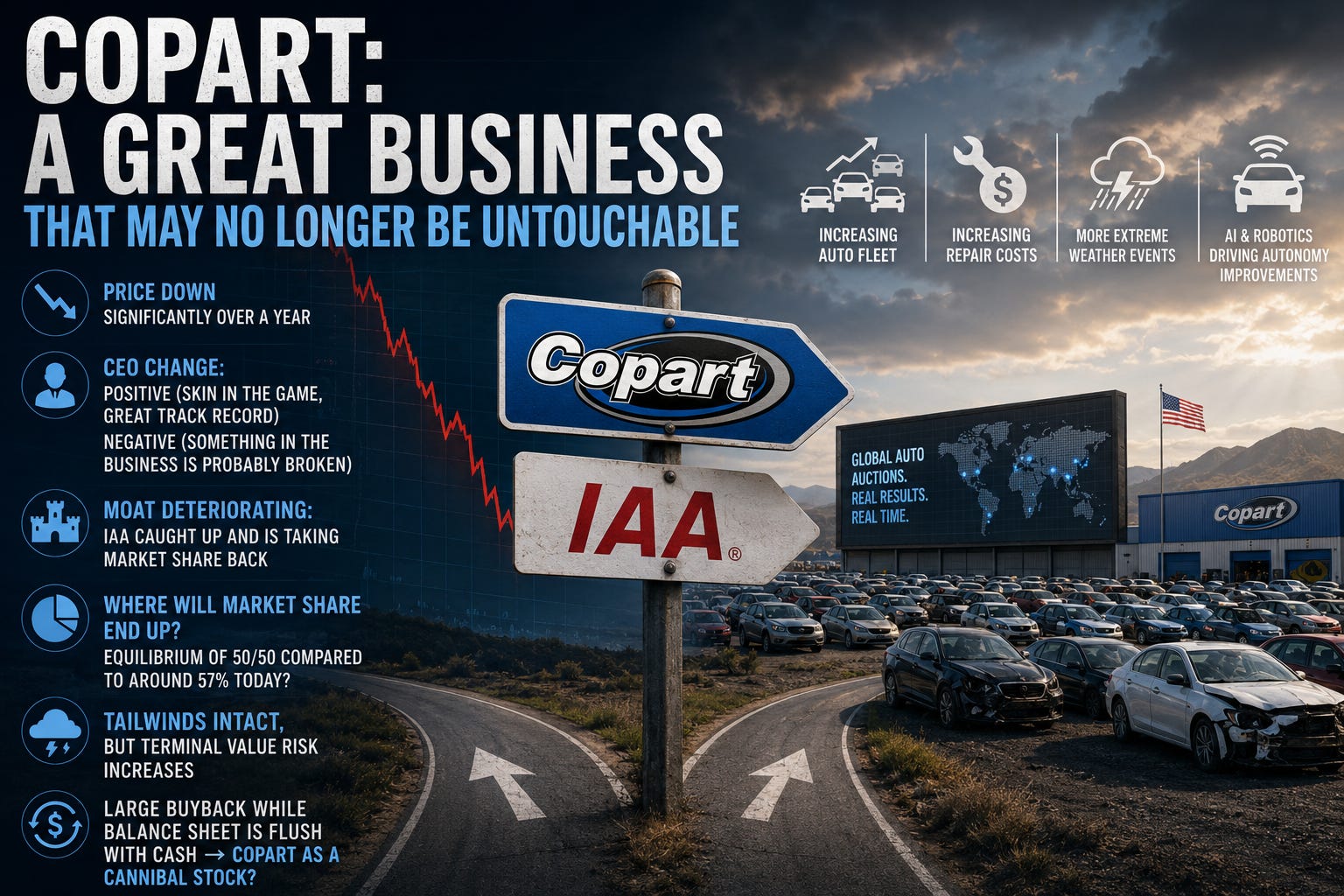
The Return of the owner operator: Reassuring or Concerning?
Founder/owner operator returns are often interpreted positively by investors:
significant ownership aligns incentives,
founders think in decades rather than quarters,
they understand the business better than anyone else,
moral should increase seeing the founder stepping back instead of some hired gun.
Jay Adair led Copart for decades and has made it to what it is now, he even married the founders daughter (talk about alignment to the founding family). Yet despite that shares traded down following the announcement of his return and the follwing investor call (very unusual for Copart to do one of those).
There is however another interpretation: Founder CEOs rarely return unless there is something to fix. The company is facing slowing growth, increasing competitive pressure and market share concerns. Bringing back the founder may signal urgency in fixing something that is broken rather than grabbing an opportunity.
Management clearly understands this concern and used the announcement call to shift the discussion toward growth initiatives rather than recent operating trends.
Three areas received particular attention:
international expansion,
domestic whole car growth,
technology and AI services.
Copart believes it still has meaningful growth opportunities ahead.
Slowing growth
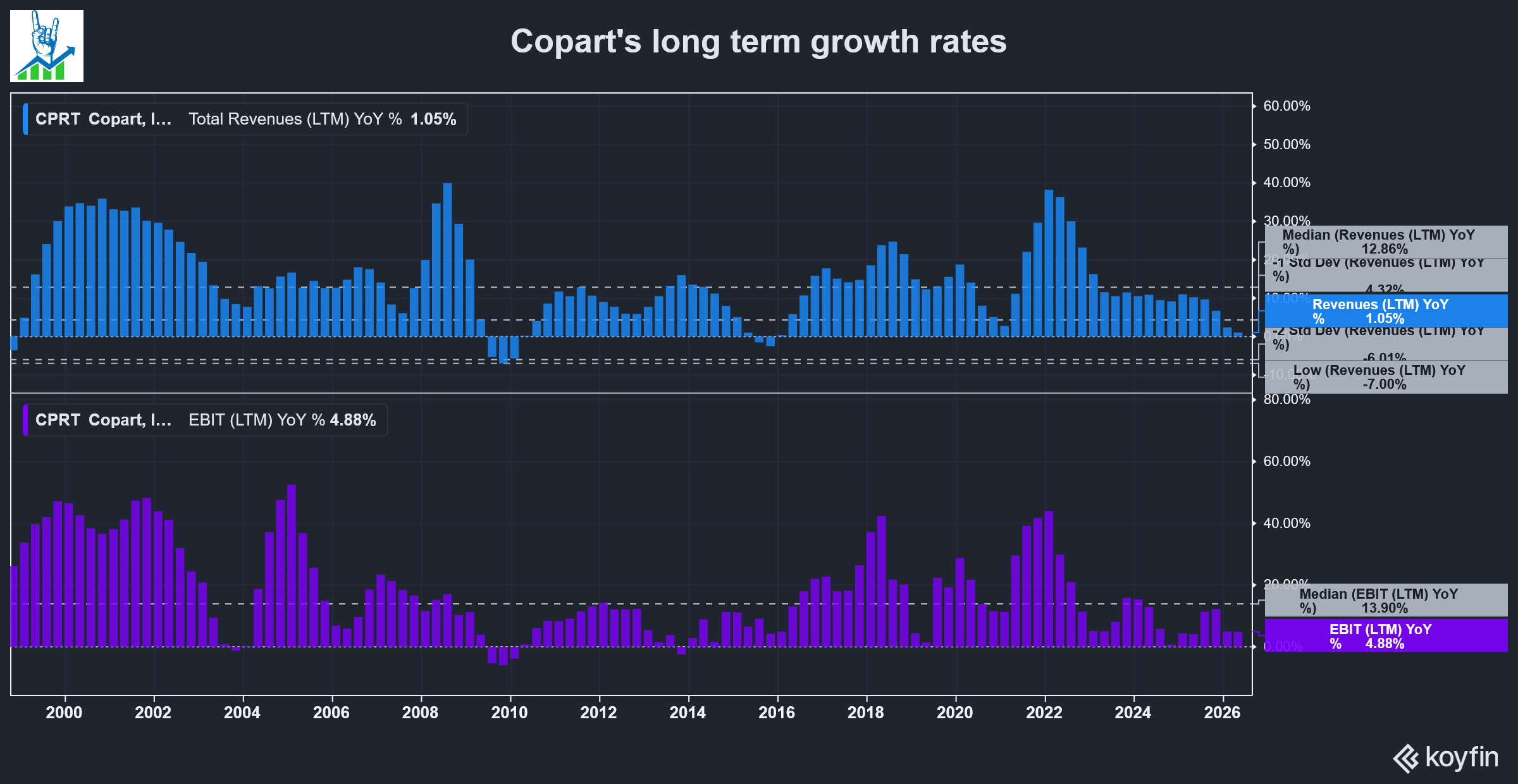
Copart has a long track record of strong organic growth, averaging 12.9% annual growth over the last 25+ years, with EBIT growing faster at 13.9%. After the initial boom of the pandemic, growth has stalled and came to a halt.
Covid created a unique scenario where we had an increase in demand for used vehicles while average selling prices (ASP) increased on inflationary pressures. With the world reopening and people trying to cope with inflation we also saw another headwind: increasing underinsured drivers. As insurance premiums got hiked unsustainably more people than usual decided to go for minimum coverage and hope that their car didn’t get into an accident. Those uninsured cars won’t get into Copart’s yards if they get totalled, leading to a headwind.
Furthermore, IAA is finally under good ownership and is competing. They’ve recently taken share from Copart and the question is if this continues. There are estimates that Copart’s market share peaked around 63% and has now fallen to 57%ish (hard to verify, so I’ll just leave this guesstimate here).
Copart’s Three Growth Pillars
Management highlighted three major growth initiatives during the CEO transition call in order to get back to growth. Fortunately, as the chart above highlights, the company has faced growth slowdowns in the past and has emerged stronger every time. Will they return this time again, keeping their average revenue growth rate over a cycle?
International Expansion
International remains the most obvious opportunity. The United States generated approximately $3.9 billion of revenue last year compared to less than $800 million internationally.
The international business is still relatively early in its development (around 38% EBIT margins for the US business and 27% international). Germany has already reached strong profitability and international revenue continues to grow substantially faster than the domestic business (in 2023 it was 10% versus 22% revenue growth, in 2024 10% versus 19% and year to date it was -2% versus 11%).
Unlike the United States, many international markets remain fragmented and lack a clear market leader. Copart may still be in the early innings internationally.
Domestic Whole Car
The whole car business receives less investor attention but may become increasingly important. Traditional Copart transactions involve insurance total losses, while whole car auctions involve:
rental fleet disposals,
off-lease vehicles,
repossessions,
dealer inventory,
government vehicles,
clean title vehicles.
This means that we have cars in better conditions that will likely get bought to be driven and not scraped. The economics are inferior to salvage auctions, becuase competition is stronger and thus pricing power is lower.
At the same time, the business offers several advantages:
Copart can leverage its existing infrastructure while reducing dependence on insurance total losses and accident frequency.
In a future with fewer accidents, whole car becomes increasingly valuable.
Management appears particularly excited about this opportunity and expects growth initiatives to start showing results within the next several quarters.
Technology Services
Management repeatedly emphasized technology and artificial intelligence during the call. The company already operates one of the largest vehicle auction marketplaces in the world and has historically built most of its technology internally. Management remains intentionally vague regarding future plans, so we’ll have to wait and see.
Few companies openly discuss competitive strategy during periods of increased competition. The more interesting takeaway may be management’s willingness to think beyond the traditional salvage auction business. Given their prudent history, we can see this as an option (upside if they figure something out that works well) and expect them not to do reckless spending.
Is the Moat Beginning to Crack?
I exited my old Copart position last year around $40 per share, partially because the valuation did not discount a cracking moat. Now shares trade almost 50% below my exit, potentially offering a new entry. For years, Copart steadily widened its lead over its primary competitor, IAA. Its owned real estate (mostly a cost base advantage), extensive salvage yard network, global buyer marketplace (real differentiation if you have lots of international buyers driving competitve pricing) and operating scale created huge barriers to entry.
Those structural advantages remain intact today of course and building a comparable physical infrastructure would require enormous capital and many years of execution (if it’s possible at all, given the limited scrap yards around). The problem is that infrastructure alone does not necessarily prevent market share losses.