
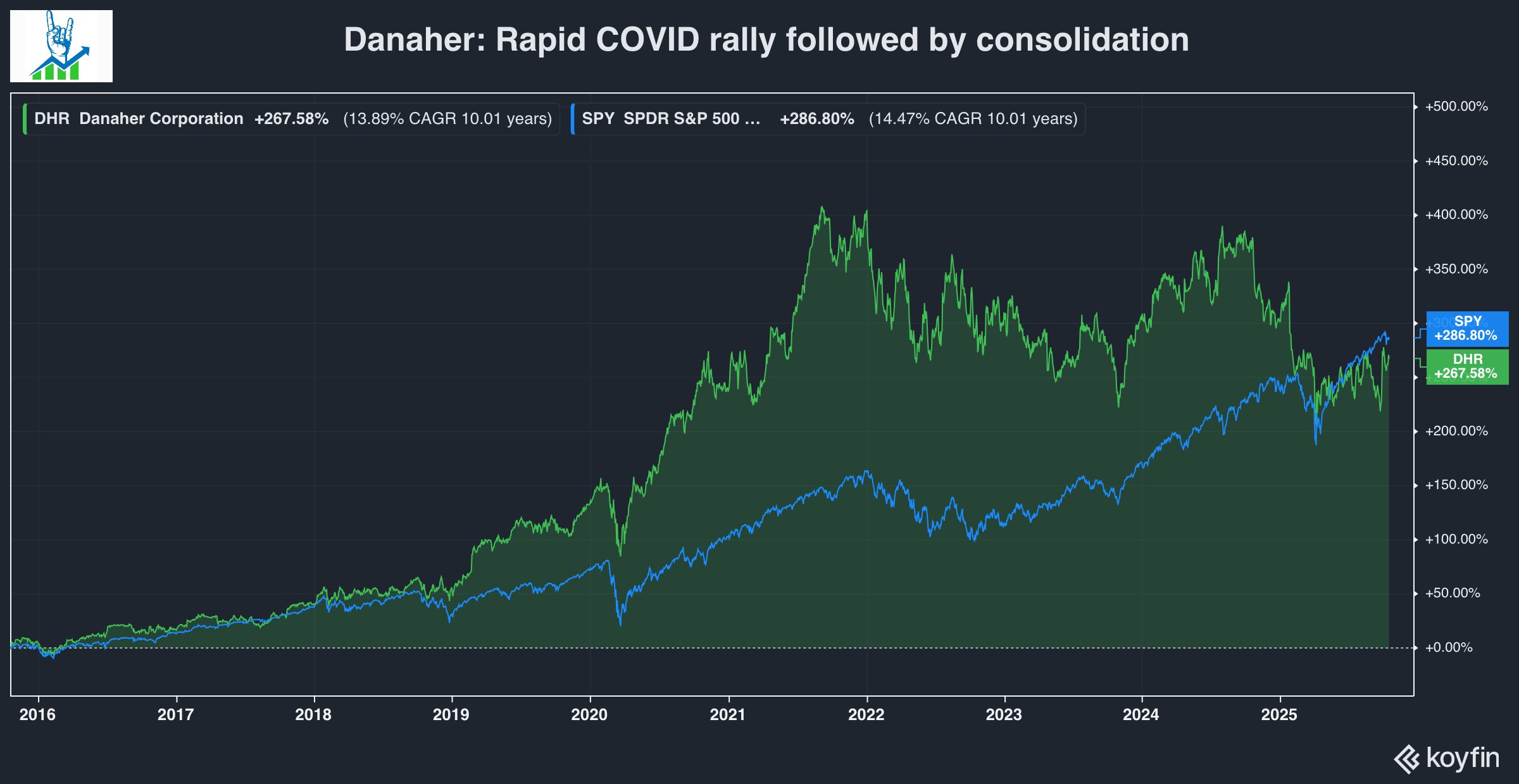
Danaher has been a long term wealth compounding machine since the Rales brothers took over the company in 1983, growing in price by 21% annually over 43 years! Over the last decade, Danaher saw rapid growth following the COVID-19 pandemic, followed by a brutal consolidation until today amidst channel destocking.
In the last part, we analyzed the business model of Danaher. Today we’ll break the company down using my quality score. Check out this post if you want more details about the quality score.
Q3 earnings
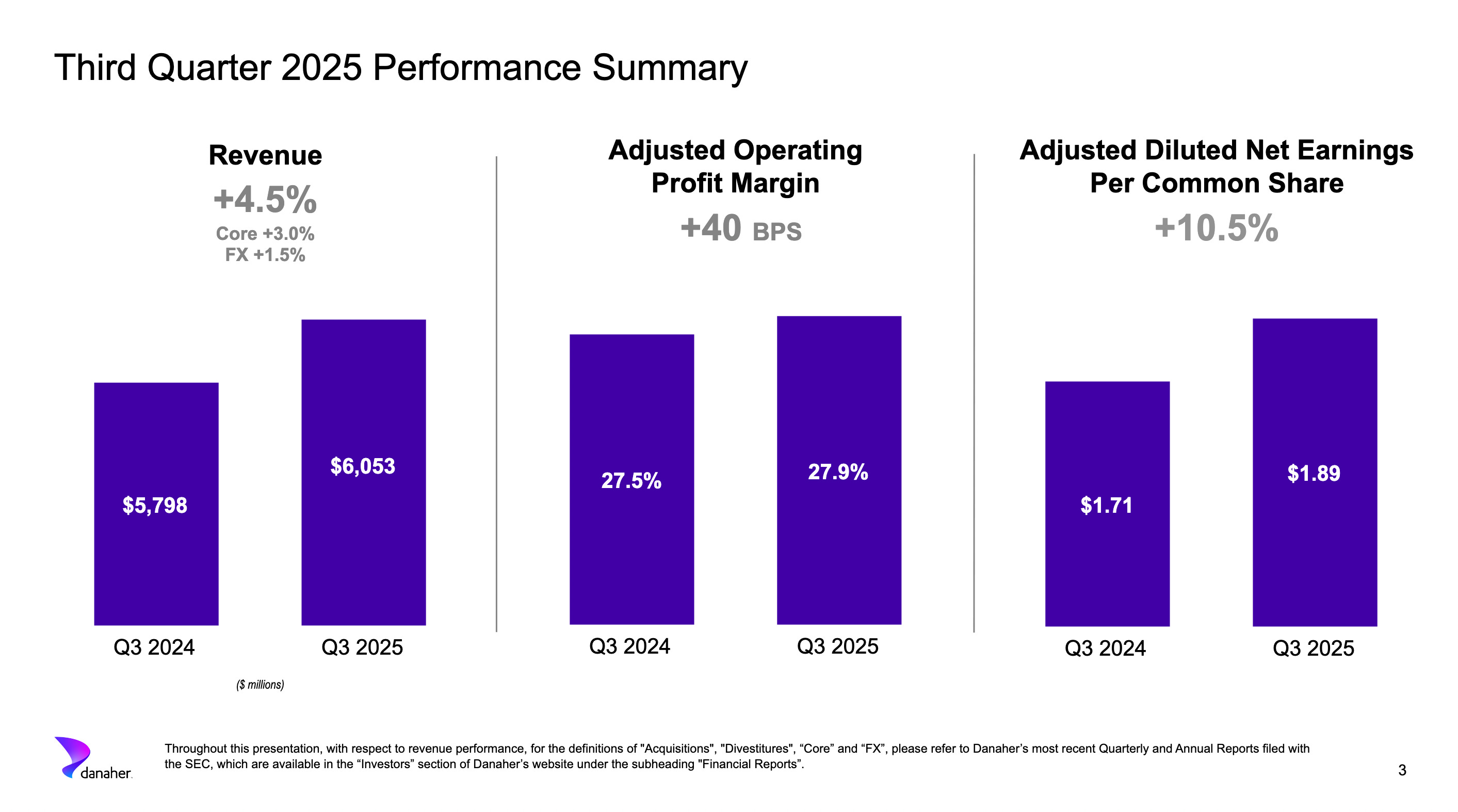
Before we start going through the quality score, I want to quickly address the results from today. Danaher beat expectations across the board showing 3% core (similar to what most companies report as organic) revenue growth together with slight margin expansion resulting in 10% Adjusted EPS growth. Shares rose quickly, but have so far given up basically all their gains from >10% at the short peak.
Biotechnology leads the charge with 6.5% organic growth and 40bps margin expansion, followed by Diagnostics with 3.5% growth and 150bps margin expansion and life sciences with a -1% organic decline and 170 bps margin compression. The company has had another impairment, so far they’ve had impairments in all three operating segments.
I’m torn on these results, on the one hand, they show signs of the recovery and beating expectations, but they still are far from the levels of growth I want to see. Management seems to like this price, as they reassumed buybacks with $2 billion in the quarter, after not buying in Q2. They did buy $5 billion last year at much higher prices however.
Quality score
Optionality/Innovation (3/3)
Danaher has a very high optionality and has shown several times in the past that they can pivot. Where most management teams are focused on growing the company (revenue and size), Danaher has a history of divesting inferior businesses and acquiring higher quality businesses. We discussed this in more detail in the first part.
Cash Conversion (3/3)
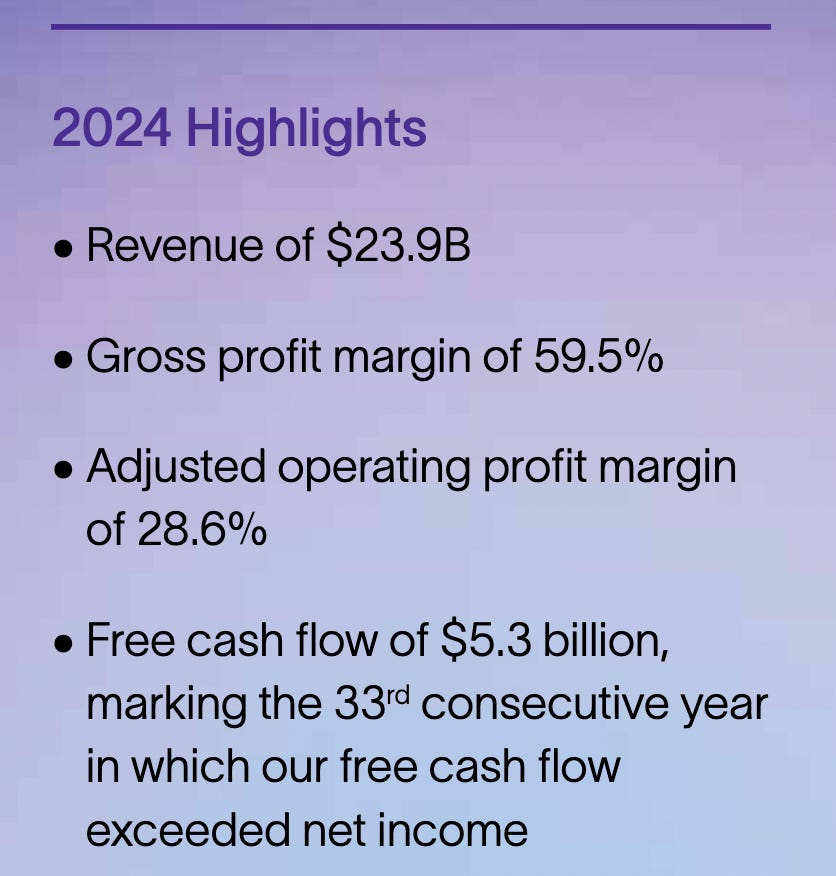
The focus for Danaher lies in free cash flow generation and the company proudly states on the 6th page of its annual report that they have exceeded a 100% FCF conversion for the 33rd consecutive year! This is achieved by a focus on high efficiency, capital-light business models and depressing reported earnings with amortization from acquisitions.
Secular Trends (4/4)
Returning readers will notice that I skipped the management alignment category: This was covered in depth in the first part and was moved behind the paywall.
Aging populations are a global trend, at least in developed countries. Japan, Italy and Germany are leading as the oldest countries, but the US is also aging rapidly. A persons healthcare spending is heavily weighed towards the later years of their life and an aging population has strong tailwinds for the health care industry. With improving technology, diagnostic solutions like Danaher develops should also increase in adoption.

Margins (4/5)
Historically, Danaher is improving its margin over time by going up market into more attractive businesses. Over the last decade, EBITDA margins improved from 22% to 31%, but they peaked at almost 37% during the peak of the pandemic. As demand skyrocketed, supply was built rapidly to satisfy the demand and fully utilized. Following the widespread usage of vaccines and the transformation of COVID-19 from a pandemic to an endemic, there was a massive destocking in the channels, leading to falling sales and margins for bioprocessing and diagnostic players.
Margins have stabilized at 31%, well above the 25% pre-pandemic, but below the peak levels. Danaher has done well to not get crushed like peers (i.e. Sartorius Stedim).
Balance Sheet (2/3)
Leverage is at a 2x net debt/EBITDA, in line with the mean leverage of 2.1x for Danaher. As a frequent acquirer, they are used to using leverage for value creating deals and then deleveraging if leverage is growing too high.
Want the full deep dive?
In the next part I talk about the remaining 10 metrics, going over the competitive advantage, growth, reinvestment, predictability and valuation of. Consider subscribing to Heavy Moat Investments and take your investment research to the next level.
I made my deep dive into Ashtead Group free—so you can see exactly what to expect: Business model deep dive - Fundamentals and Valuation deep dive
As a premium subscriber, you’ll get:
Detailed Research on high-quality global compounders and European champions, with deep fundamental & valuation analysis.
Actionable Investment Pitches – Ideas with high upside potential and limited downside.
Earnings Breakdowns on key reports and market reactions.
Real-Time Trade Alerts on all my portfolio moves, plus access to the premium chat.
Exclusive Investing Tools, including my Inverse DCF template and more.