IPOs have a bad name. In recent years, many investors were left holding the bags after tech companies with ambitous targets and even larger operating losses raised capital by going public at exorbitant multiples (often revenue, because there were not even adjusted profits). The acronym I(t’s) P(robably) O(verpriced) has made its way into the vocabolary of many investors, especially in the US markets.
Vehicles like SPACs that lowered the barriers and regulations to go public have multipled this problem. Common problems with new IPOs are:
Raising capital while growth rates are very high → how sustainable are they?
Depending on external capital with aggressive reinvestment → strong cash burn
Strong dilution from options, warrants and employee share based compensation
Complex structures like TRA liabilities → insider having special priviledges
Founders cashing out and a change in culture as a public company
While these problems often occur, they don’t always have to be there. Today I want to analyse a somewhat recent German IPO, innoscripta AG. It does not share many of the same issues IPOs have: The founders and employees own 80% of shares, the company is highly profitable and is leading in an overlooked niche. They only IPOed to raise awareness and improve credibility for their company; they have a net cash balance sheet and strong cash flows. In this post I’ll cover the business model of innoscripta, its economics and further scale potential, management team and valuation.
Btw, my friend René Sellmann helped me a lot talking about this case. Check out his deep dive too.
Innoscripta AG
Innoscripta is a relatively young company, having been founded just a little over a decade ago. The company is serving a very overlooked market: government R&D grants. These grants are embedded into law in all OECD (Organisation for Economic Co-operation and Development) countries according to the CFO, but few companies actually claim them due to the effort needed to claim the grants. Despite its benefits, only 28.5% of R&D corporations utilized these subsidies in 2022, up from less than 11% in 2021.
Up until 2021 the innoscripta was just a consultancy preparing statements for clients, when they developed the Clusterix platform to automate the process for R&D grants with a focus on Germany. To get customers set up on Clusterix they still need consultants that go through the process with them and file everything. This is mostly done via freelancers. Filings ideally don’t change much over the years and take months up to a year until the first payout, so the consulting costs decline a lot after the first successful claim. That means innoscripta enjoys operating leverage after one year.
Competition mainly comes from consultancies, tax agencies and lawyers doing the work manually using spreadsheets and papertrails to get the grants. According to themselves, innoscripta is the only global player with a digital end to end solution for this process. Despite this, it’s hard to call this a true SaaS play, as there is consulting work as well embedded.
Each country can select the level of incentive they want to do and the requirements change from country to country. Generally it does involve tracking the actual time and resources the R&D teams invest, including precise descriptions and outcomes of actions. R&D does not only include research of new technologies, but also i.e. software development where an existing component gets adapted for a different use case, making these R&D grants widely usable for many sectors. There is also a strong incentive to use a credible platform instead of DIY or AI, because if an audit finds bad or wrong documentation it can lead to a tax fraud allegation.
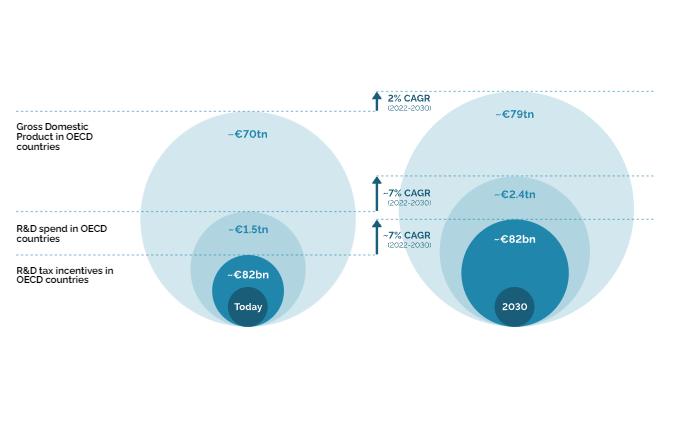
Few companies track R&D and it is often a hard to quantify outcome. Outside of subsidies it also means that companies can not accurately assess how successful certain projects or teams are, leading to inefficient capital allocation. While the tax incentives are the main reason why customers use innoscripta, it’s an additional advantage. Generally, the business is aiming to bring transparency to R&D by breaking it into its individual steps, tracking and documenting it.
Germany is the core market of innoscripta, but they claim that you can already handle other countries as well, especially interesting for multinational companies with R&D teams and budgets in several OECD countries. Their Clusterix platform has a no-code set up, which allows them to set up new geographies for internationalization or new regulatory setups rapidly within the existing software solution (they target France and the UK for expansion next). A flexible system is crucial for this business, because of the frequently changing requirements. This speeds up the go-to-market process considerably. In the future, multinational companies could benefit from filing in multiple countries, that’s the best way to internationalize in my opinion.
Currently eligible R&D expenses can get grants of up to 25% with a maximum of 12 million Euros (recently increased from 10 million) starting in 2026. Additionally, the German Forschungszulagengesetzt will start to accept general expenses aside just clearly R&D related expenses, aligning the R&D credits more with the realistic OpEx and CapEx a business has to invest.
Why are economics so great?
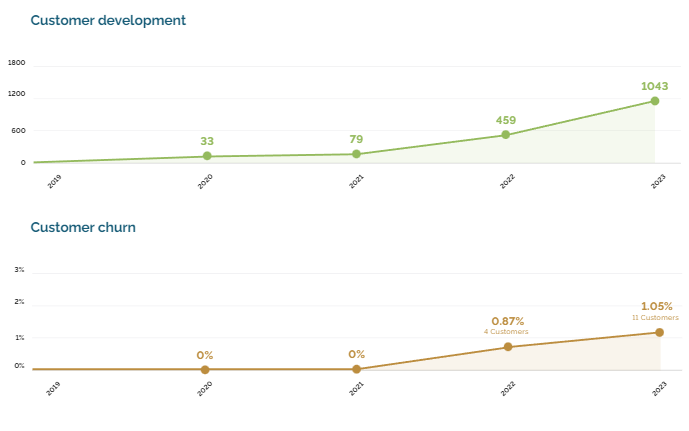
Innoscripta generates high growth rates of 48% annually over the last three years with growing margins to a mind blowing 59% in the trailing twelve months. Let’s talk about the economics of the business and why it’s able to scale this profitably. It’s not your usual SaaS business, instead it’s using an innovative pricing strategy, trying to lower the hurdle to try out the software and reduce churn (just 2% currently). Over the last five years they scaled the business to over 1,000 customers.