
Portfolio update: Increased diversification amidst an increasingly exuberant market
My portfolio grew from 8 to 13 positions again. Let's reflect on that.

Over the last months, I’ve thought and talked a lot about the balance between diversification and concentration. At its most extreme point this brought me down to 8 positions in my portfolio. While many investors wouldn’t call that extreme, others with 30+ positions would probably call me crazy. Investing is a deeply personal story and so is portfolio construction.
More important than our individual picks is exposure to correlating trends. All stocks can be victims of system shocks, but besides those systemic risks we also have idiosyncratic risks for sectors and companies.
Back in November, with just 9 positions, I was at my most extreme concentration with 75% of my portfolio between software and payments businesses (and one could argue that 13% of the remaining portfolio was exposed to similar trends). Those 75% were between 5 companies, but they still correlated to two broader trends:
35% fintech: Out of favor sector with strong competition and a few ugly crashes with companies like Fiserv or PayPal showing deteriorating fundamentals. As multiples fell I continued to double down on this.
40-47% software/SaaS: Increased fear of disruption by AI and rapidly falling multiples as people started to discount terminal risk differently.
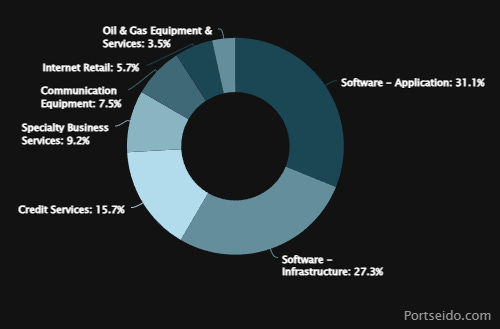
While both of these trends do not impact the companies right now, it changes the perception of the market and I’d argue that all those businesses weren’t and still aren’t sleep well at night stocks. For fintech, they were and are very cheap, but we also have a very competitive environment with lots of moving parts. For software, the development of AI is exponential and humans are notoriously bad at predicting exponential change. It’s naive to say that we know how AI will impact software businesses in 5 years time, so an outsized bet certainly has risks.
What I changed since then
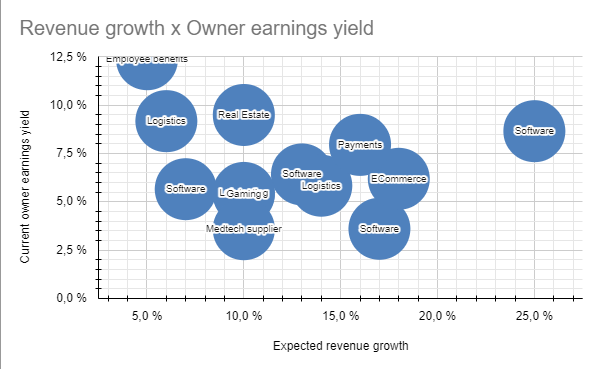
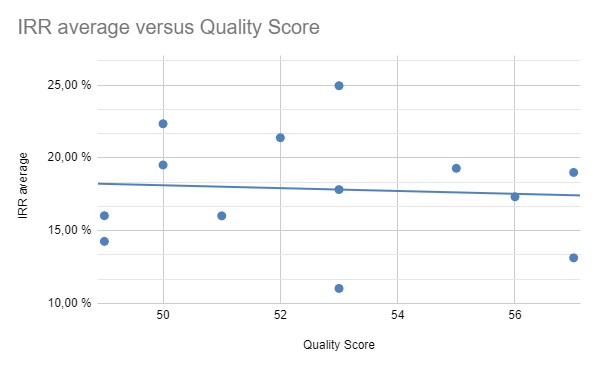
Over the last months I increased the number of positions again to 13 positions. I believe that this wasn’t dilutive to either quality or returns of the portfolio, as can be seen in the matrix below, my companies still have a strong mix between fast revenue growth rates and high starting yields. I focus on those two variables because it’s what drives value over the long term in my opinion. Revenue growth and cash generation capabilities of a company are what drives value.
I still hold firm on my hurdle rates between 15-20%, depending on the business quality. Diversifying for the sake of it doesn’t make sense to me. I’ll admit that I more often bought something closer to a 15% IRR now, but that’s still a fine expected return.
In order to shield myself more I set up a rule to not have more than 25% of exposure in one sector. Exposure to me means my cost base, if a stock rans up on good performance I’m fine keeping a higher exposure. Technology has significantly declined, as I have trimmed my software and fintech names a bit and put those funds into other verticals.
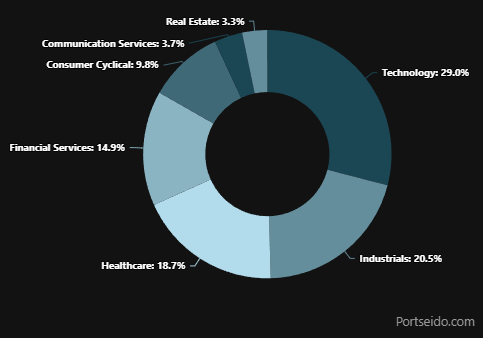
I have to say, it feels a lot better to not depend on just two trends so much. It’s painful to bet against the market. We are in a market where a lot of stocks are exuberantly priced to dominate, while others are left for dead as capital flows out. I believe that it’s a good time to build a portfolio and if extreme value dislocations happen, like Edenred at 16€ (~9% dividend, >20% owner earnings yield while growing 6-8% organically excluding regulatory impacts) then we should size them higher. In the case of Edenred, I trimmed the position after the extrem dislocation has corrected itself a bit. It’s still very cheap now, but it’s fine to take some risk off the table and rotate it.
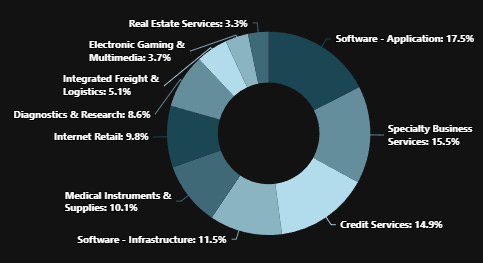
Overall, I have achieved my goal with the portfolio restructuring: I can sleep better at night. During the height of the software AI scare I noticed that I thought way too much about this exposure. Optimizing for high expected IRR is great, but we can’t ignore the risks, both systemic and idiosyncratic risks. Let’s quickly go over the specifics of my company:
