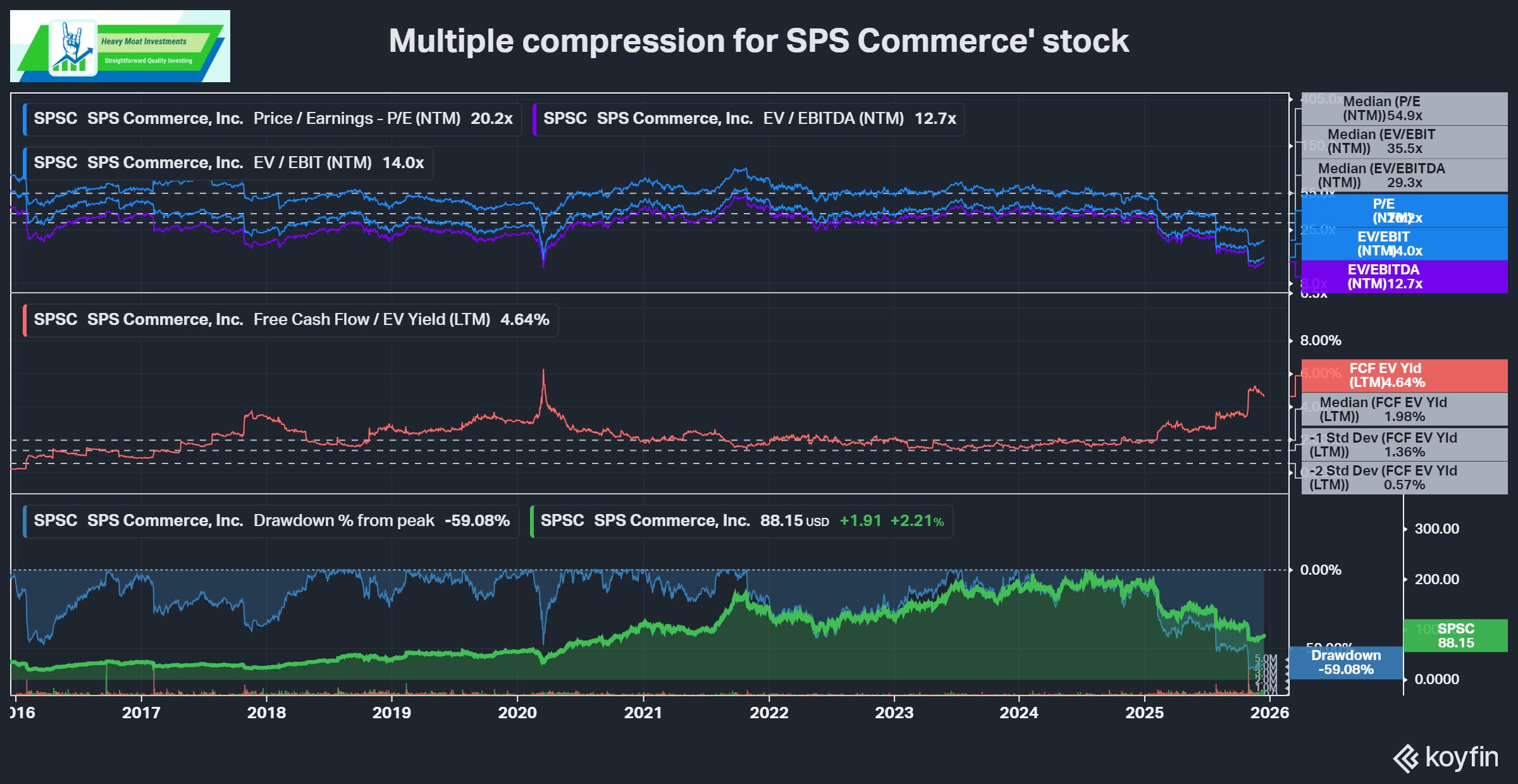
For more than a decade, SPS Commerce was a textbook example of a high-quality small-cap compounder, growing from $20 in 2016 to over $200 in late 2024. Revenue grew steadily, margins expanded, customer retention remained high and the stock followed the fundamentals. Investors were willing to pay up for that consistency driving up the multiple to above 40x EBITDA most of the time.
That narrative has changed abruptly and the stock has fallen roughly 60%, wiping out several years of gains and pushing SPS Commerce into a very different bucket in investors’ minds. Is this now a high-quality compounder temporarily out of favor or is the market correctly repricing a business whose best days are behind it?
To answer this I went over the industry, its core product, management team, M&A and finally valuation. Let’s get into it.

Industry and Product: What SPS Commerce Actually Does
The Core Business
SPS Commerce operates a cloud-based retail supply chain platform, where it connects retailers, suppliers and logistics companies to exchange structured business documents like purchase orders, invoices, shipping notices, in a standardized, automated way. EDI (Electronic data interchange) is one of the core protocols used and has been a standard for a long time and often uses older technology like EDIFACT or XML, so a disruption from API-first competitors is definitely a risk to consider. SPS does run a protocol agnostic strategy however and implements whatever way a customer needs to communicate with all its partners.

EDI, while often being called antiquated, has its advantage in the established workflows that are already present within most companies:
Retailers want suppliers to comply with strict data and process requirements.
Suppliers want access to retailers without building custom integrations.
SPS Commerce sits in the middle, acting as a translator, validator and compliance layer.
The business model is subscription-based, recurring, and sticky. Customers pay monthly or annual fees, often scaled by transaction volume or partner count. It works, so most companies won’t rip out its established workflow, resulting in low churn and recurring revenues, so the past premium valuation was not without reason.
Carbon6 acquisition: The Amazon Ecosystem Deal That Backfired
With the deal to acquire Carbon6 in early 2025, SPS made a strategic push into the Amazon ecosystem. The $210 deal (40% stock, 60% cash) for $40 million in revenue and $5.5 million in AEBITDA was pretty expensive and brought software tools to Amazon sellers, especially revenue recovery tools (i.e. defending against claims).
The deal logic initially looked compelling:
Amazon is a dominant retail platform,
Suppliers need compliance tools to operate efficiently within Amazon’s marketplace,
SPS Commerce aimed to become a key infrastructure provider for those sellers.
In practice, this turned into a strategic misstep as Amazon changed its marketplace rules and technical requirements shortly after, undermining the economics of the deal and reducing the value proposition for SPS Commerce. An Amazon ecosystem focused publication noted:
Their sophisticated AI systems—which now automatically highlight product features, optimize listings, and deliver hyper-personalized shopping experiences—create a technological ecosystem where FBA sellers face the impossible choice between investing heavily in Amazon’s ever-expanding suite of “services” or disappearing into the algorithmic abyss of search result obscurity.
This shows that Amazon will continue to push for taking ever high take rates through more services. Amazon does not need SPS Commerce, but SPS Commerce needed Amazon’s rules to remain stable.
With $210 million the deal is not threatening the company, but it raises questions about the vision of management and competition from Amazon itself towards part of the business. At the very least we should expect some impairments along the way.
Is the business still good now?
Over the last five years, SPS grew revenues at a 19% CAGR while EBITDA margins improved slightly from 21 to 22% and the balance sheet remains clean with a large net cash position. The valuation dropped sharply from a median EV/EBITDA of 29x to just 12x!
Anson has taken a stake in the business a few days ago and acts as an activist pitching a sale of the business to close the gap to valuations in peers. I am often not a fan of activist investors pushing for short term realization of value in a growth story. So is this an opportunity or a rapidly decelerating business that deserves a structurally lower multiple?